Strange day today. Started strange, when I was awoken by my alarm at what I thought was 8 AM, but turned out to be 7, because my clock was running an hour fast. I didn't realize it for about an hour or so. Continued to be strange and then ended strange. Nothing specific, just a feeling.
Is this what Spring brings in? Cold nights and late night mystery labors by crews with klieg lights at the Masonic Home?
D.
Tuesday, March 31, 2009


Friday, March 27, 2009
Gold Star
Welp, I got me an 'A' in my Algebra class. That's five tests, with scores (respectively) of 100, 100, 95, 86, and 99. In case you can't tell, the subject got progressively more difficult, then much easier. In fact, sections three and four I spent the most cumulative time on (about a month), and I still kind of blatzed the test for section four, which was all about adding and multiplying and dividing polynomial fractions. Lots of factoring of the kind where one accidentally reversed sign can give you an answer that would have your moon mission landing in Akron, if you were an orbital scientist employed by JPL.
Section five, on the other hand, was so easy that I almost lost all confidence, in that 'there's no way that I got that right with no effort' kind of way. Just square roots (radicals) and the quadratic formula. In fact, I took test four on Monday after ten really intensive days on the subject, and had intended to take all this week to really cram section five to make the noon Friday deadline to complete the course. Turns out I already knew it cold, and decided on a whim to scoot over to RCC and take the test after work on Wednesday. My best guess as to why I did so well with this part (apart from square roots just being rote memorization, rather than actual thinking) is that I must have also put in the effort to memorize the quadratic formula a couple of decades ago, and I found it easy enough to access that lost part of my brain and recall it with very little effort (which is the exact amount of effort I like to apply).
Now comes a brief pause in my mathing, just enough time to relax. Then it's back onto Trigonometry, Pre-Calculus and then Calculus. The deadline here is that my father is moving to Whitehorse, Yukon in August, and my Learning Annex Math Course goes with him. So I'll be relaxing the schedule just a little - but then it's on to math of the kind that made me stop taking math as soon as I was allowed in high school. Shudder for me, won't you?
D.
Wednesday, March 25, 2009
Stupid Morning Epiphanies, or, 'The Ironic Shirelles'
I define myself largely as a musician and songwriter. By extension, this means that I regard myself as having refined, informed taste in music. Why, then, do my tastes diverge so very far from what's generally considered the canon of what's good? I mean, it would be one thing if I liked all the critical favorites and then had my proudly open dirty little secret prog love on the side - every music lover has that one thing that they know is impossible to defend, yet they love it without irony. So if my library and pantheon were to consist of the acknowledged greats - a little Graham Parker here, some Patti Smith, Laura Nyro, Radiohead, etc. - I could justify my love of emotionally distant and pointlessly intricate tripe* as a mild eccentricity.
But no. Twenty years after I'm supposed to have moved on to more mature stuff, I still find the greatest listening pleasure to be had in comparing live performances to studio versions of Supper's Ready.
For all of that, my other favorite music is new wave, the explosion of (mostly) ultra-pared-down rock that ruled from 1977 to 1984 or so. It's where punk went to get top 40 action - the love child of disco and garage rock. Many of the artists of new wave took their cues (as had the generation before them) from the black soul and r&b artists of their youth. Talking Heads took more from Al Green than just the one lone cover. Gary Numan polished up the Parliament synth groove so successfully that he ended up being a favorite sample of hip hop producers thirty years later. The Police rode in on the ska/reggae wave that swept through the UK, also with Madness, the English Beat, UB40 and... uh, Eric Clapton?
Anyway, I'd suspect that a lot of the reason I like new wave is for the weird ghostly echoes of black musical forms. So why, then, do I finally have to admit that I have little love for Elvis Costello - a man who is generally perceived as being among the finest songwriters and performers of his generation, who was at the vanguard of the new wave and who slathers his work with deep soul references?
Wrong references.
Listening to the radio in the car this morning, it hit me: Christ, this fucking Costello song sounds like the wall of sound on the morning after. Byzantine, echoey production with tambourines and clanging piano, like the shit you'd fire a wedding band for playing. Really, they all sound like that. Billy Joel got it out of his system with one song, but Costello's entire career is one long weird ironic take on The Shirelles. Even as a producer, he drags down Squeeze with that slop.
The dead giveaway - the real hand-tipping moment - was when Costello paired up with Burt Bacharach (who I actually rather like) for new songs that were supposed to artificially generate nostalgia for that 60's period of Bill Building dominance. In a way, it worked: upon seeing Costello and Bacharach performing a song live with a Montovaniesque string section on Letterman one night, I became instantly nostalgic for the period before I heard them do it.
Anyhow. I finally have a definitive answer as to why I do not like Elvis Costello. So stop pestering me about him.
D.
*Curious note: though the phrase 'emotionally distant and pointlessly intricate tripe' can easily apply to Phish, I do not like them. At all. The earheart is a strange creature.
Bedtimes and Broomsticks
Really, I should be sleeping - it's not that late (about 12:30), but I've spent 12 of the last 14 hours staring at a computer, plugging in articles and such, and I'll be doing that again for several hours tomorrow. So it's not so much that I'm tired, it's just that I'm Macintoshed out. I suspect that Tuesdays on the Rambler for the next while will be slim, as a result.
Case in point.
D.
Case in point.
D.
Monday, March 23, 2009
Behind the Panels
One thing is for sure: at some point in the hopefully not-too-distant future, I'm going to look back at the winter and spring of 2009 and let go one huge mother sigh of relief. Really, I feel like I've been holding my breath one way or another for most of the past decade, and the last few months have had me hitching it tighter and tighter. The expanding oxygen-poor dead zones in the Pacific off the Oregon coast aren't due to any kind of global warming phenomena - it's because I've been holding all the extra air in that the fish need. Sorry, fish.
Bits of business: I did promise that I would fill in the story behind that comic from Friday, didn't I? Not so much to tell: the editor of "Signal to Noise" (the music magazine that I did the Street Fair comic for a few months back) contacted me back in January and proceeded to give my ego one of the better strokes it's had in many a year - namely, that David Greenberger was going to be writing a comic for the magazine, and out of all the samples that the editor (hereafter known as 'Peter') had shown him, he decided that he wanted to work with me. Which was (is) very cool, considering the place in alternative culture that Greenberger holds and the artists that he's had illustrate his stories in the past. I'll really have to track down a copy of 'Duplex Planet Illustrated' to find the full list, but Dan Clowes and Jason Lutes were definitely in there, and that's company I'm pretty pleased to be in with.
But the main thing that made it cool was that when I first responded to the editor's ad for submissions last summer, it was with the hope that I'd get a chance to collaborate - something I've always enjoyed but had little chance to do. I was sort of surprised that no-one on his staff had any script or anecdote they wanted to see as a one-page comic, so I semi-reluctantly wrote one myself and they happily ran that. From my perspective, the first comic was a mixed bag - decent drawing and nice concept, but dry and kind of pointless.
So when Peter asked me if I wanted to draw a comic written by David Greenberger for the follow-up, it was a bit like playing bass in an anonymous amateur bar band for a first gig, and then getting asked to produce a Hüsker Dü record. I'd wanted to draw a comic from someone else's script. I was thrilled to have that someone be a writer whose work I've admired for some 20 years.
The actual process was quick and straightforward enough. The script itself was essentially just the monologue, accompanied by Mr. Greenberger's suggestion that it should be illustrated with the speaker in the center, surrounded by unspecified images of recording and music technology, past and present. I thought about it for a little bit, and offered the concept of the panel transitions instead, with a marked difference in illustration style between the speaking panels and the spot illustrations - playing off of a documentary idea, with black & white interview footage and color flashbacks. He liked it, and I did the comp, below:
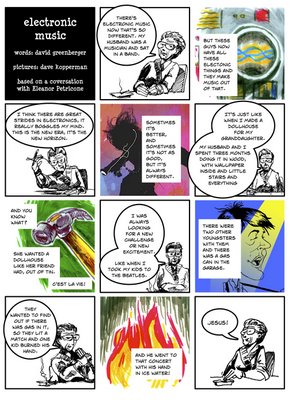
You'll note that the final parallels it almost identically - the simplicity of the approach let me off the hook when it came to laboring over extensive drawing. I have to give credit to Marina, here, for offering the suggestion of the iPod image, when I couldn't think of what would represent modern electronic music. Without a doubt, the sharpest idea on the page. The only change that Greenberger had was asking me to make her hair a little more feminine, which is a spot-on criticism, in retrospect. I'd been making the mistake of thinking of her as a wiry old broad, but it's sometimes easy to get too caught up in little ideas like that and forget to convey the basic information visually as fast as possible. If there were any confusion about the gender of the speaker (she does look pretty mannish in the original sketches), it would bog the reader down.
The final color illustrations were done very, very quickly, with lightbox, watercolor, sepia ink and colored pencils. I quickly abandoned the idea that I was going to try to get all of the black and white and color images produced on the same page of original art - the logistics of that were daunting and would have added hours of work time. Doing each color illustration separately and then placing them in the layout digitally let me do the entire final page - pencils, inks, letters, color, and assembly - in record time. And I have to say I'm much happier doing real world color than computer color, which can be tedious to produce and overdone.
At any rate, both Peter and David Greenberger were happy with the results, and hopefully we'll be doing another of these sometime closer to the summer.
I'm hoping to put all of these little experiments with form and media together into something a little longer - the 'Renunciation' 10-page story that I mentioned here back in Spring of '07 would be a perfect candidate for the watercolor, prismacolor and sepia ink method.
D.
Bits of business: I did promise that I would fill in the story behind that comic from Friday, didn't I? Not so much to tell: the editor of "Signal to Noise" (the music magazine that I did the Street Fair comic for a few months back) contacted me back in January and proceeded to give my ego one of the better strokes it's had in many a year - namely, that David Greenberger was going to be writing a comic for the magazine, and out of all the samples that the editor (hereafter known as 'Peter') had shown him, he decided that he wanted to work with me. Which was (is) very cool, considering the place in alternative culture that Greenberger holds and the artists that he's had illustrate his stories in the past. I'll really have to track down a copy of 'Duplex Planet Illustrated' to find the full list, but Dan Clowes and Jason Lutes were definitely in there, and that's company I'm pretty pleased to be in with.
But the main thing that made it cool was that when I first responded to the editor's ad for submissions last summer, it was with the hope that I'd get a chance to collaborate - something I've always enjoyed but had little chance to do. I was sort of surprised that no-one on his staff had any script or anecdote they wanted to see as a one-page comic, so I semi-reluctantly wrote one myself and they happily ran that. From my perspective, the first comic was a mixed bag - decent drawing and nice concept, but dry and kind of pointless.
So when Peter asked me if I wanted to draw a comic written by David Greenberger for the follow-up, it was a bit like playing bass in an anonymous amateur bar band for a first gig, and then getting asked to produce a Hüsker Dü record. I'd wanted to draw a comic from someone else's script. I was thrilled to have that someone be a writer whose work I've admired for some 20 years.
The actual process was quick and straightforward enough. The script itself was essentially just the monologue, accompanied by Mr. Greenberger's suggestion that it should be illustrated with the speaker in the center, surrounded by unspecified images of recording and music technology, past and present. I thought about it for a little bit, and offered the concept of the panel transitions instead, with a marked difference in illustration style between the speaking panels and the spot illustrations - playing off of a documentary idea, with black & white interview footage and color flashbacks. He liked it, and I did the comp, below:

You'll note that the final parallels it almost identically - the simplicity of the approach let me off the hook when it came to laboring over extensive drawing. I have to give credit to Marina, here, for offering the suggestion of the iPod image, when I couldn't think of what would represent modern electronic music. Without a doubt, the sharpest idea on the page. The only change that Greenberger had was asking me to make her hair a little more feminine, which is a spot-on criticism, in retrospect. I'd been making the mistake of thinking of her as a wiry old broad, but it's sometimes easy to get too caught up in little ideas like that and forget to convey the basic information visually as fast as possible. If there were any confusion about the gender of the speaker (she does look pretty mannish in the original sketches), it would bog the reader down.
The final color illustrations were done very, very quickly, with lightbox, watercolor, sepia ink and colored pencils. I quickly abandoned the idea that I was going to try to get all of the black and white and color images produced on the same page of original art - the logistics of that were daunting and would have added hours of work time. Doing each color illustration separately and then placing them in the layout digitally let me do the entire final page - pencils, inks, letters, color, and assembly - in record time. And I have to say I'm much happier doing real world color than computer color, which can be tedious to produce and overdone.
At any rate, both Peter and David Greenberger were happy with the results, and hopefully we'll be doing another of these sometime closer to the summer.
I'm hoping to put all of these little experiments with form and media together into something a little longer - the 'Renunciation' 10-page story that I mentioned here back in Spring of '07 would be a perfect candidate for the watercolor, prismacolor and sepia ink method.
D.
Hulullujah
After spending a few hours this morning reviewing math with my dad, I came home and spent the rest of the day in bed with Yesenia, watching stuff on Hulu. Good way to spend a Sunday, I must say.
D.
D.
Saturday, March 21, 2009
Here's something...

...I'd been saving for a rainy day. Just the comic, now - I'll fill in the story of its making tomorrow.
D.
Subscribe to:
Posts (Atom)