In a complete non-sequitur, Anonymous commented on yesterday's entry with a question on my feelings about the high-prog band Renaissance.
Here's the dialogue, for those who can't be bothered to scroll down and check yesterday's comment section:
Anonymous said...
On a completely unrelated note...do you know of the band Renaissance? What do you think? Worth getting? I heard one really great song so far.
Dave Kopperman said...
I'm not the greatest expert on Reanissance. I have a couple of records (Sheherezad and Live at Carnegie Hall) and I've enjoyed them, but baroque grand piano mixed with rock is kind of a tough sell with me. The Live disc is excellent, though.
Maybe I'll listen again and give myself a better idea of my own response...
Anonymous said...
I really like the song "I Think Of You"
At which point I decided to take this one out front and show it to the nice people.
For those who haven't heard them - or heard of them - Renaissance were a 1970's prog band that centered their sound on rolling grand piano in a baroque style and (a rarity) a female lead singer, named Annie Haslem.
Turns out I have four of their records, all on vinyl. The two I mentioned, plus "Prologue" and "Novella." I threw some on earlier, as backdrop for arriving trick-or-treaters. None of them have I Think of You on them, but I checked out a snippet over at iTunes. Nice song. I've never heard it before. Right in their pocket, stylistically. From what I've heard on their four albums, the mid-70's line-up handled smaller ballads pretty well, but they tended to get really lost and rambling whenever they tried to rock it up - Annie Haslam's voice works very well over softer accompaniment, but when she has to push it, all her sweet shading gets lost, and (to me) she ends up sounding kind of shrill.
For contrast, compare this sweet, soft ballad, Forever Changing:
with this song, from 1977:
Admittedly, she doesn't sound 'shrill' on this one - just a little out of place - but on some of the heavier stuff from the records, it's just harsher than they should go.
The stuff that's aged the worst (as with most prog bands) are the extended instrumentals, which don't seem to differentiate themselves from the songs at the arrangement level enough to justify them jamming out. For starters, there isn't a moment's worth of improvisation on an entire album's worth of their instrumentals, and while improvisation is far from a necessity for good instrumental music in rock, when the dial is turned too far the other way into 'tightly arranged riffing for days, man,' you're just left to confront a lot of very soulless puffery, sort of like Phish if Tori Amos and her piano were dropped into the mix. Secondly, the band plays exactly the same whether Haslam is singing or not, which is kind of odd - maybe it's me, but when the singer is singing, the band should give them a little room to do it, and then step out to fill the space when they're out for a few measures.
All of that having been said, I really do like their ballads, and I think I'm going to track down a couple of their earlier records.
Why earlier?
If Renaissance is anything like every other progressive rock band, their early work will have a sweetness and soul, with the band playing soulfully together for the express purpose of making a unified sound, and the recording engineer will ensure that the instruments will be warm and inviting, and the voice will sound completely a part of the band. Plus, the compositions will be shorter and more melodic, and the lyrics will be worth listening to for poetic imagery mixed with some substance. Later records will have them every member of the band competing for room and to see who can fit the greatest number of notes into the shortest amount of time, the overall sound will have sifted from grandeur to bombast, and the lyrics will have gone from charmingly cosmic to mind-numbing stupidity.
Sadly, it's a formula that every prog band repeated without fail. Only those that were able to move out of prog entirely - see Genesis - were able to avoid that fate. People may take issue with Phil Collins's remaking of the band into an overly smooth pop machine, but if they'd kept on progging, they'd have ended up sounding like Dream Theater, which is the worst fate that can befall both a band and an audience. And possibly a planet.
(Careful with that Dream Theater link - it's ear-blisteringly bad.)
(In the category of band that kept progging way after it was time to change genres, worst offenders? As in everything else bad in prog, it was Emerson, Lake and Palmer.)
Anyway, I couldn't find a version of I Think of You by the band, so I'll instead have to share with you this curiosity that I found on YouTube:
You know, I kind of like that? I mean, he's no Tay Zonday, or nothing, but, still...
D.
Wednesday, October 31, 2007


Tuesday, October 30, 2007
Fan Service
Click images for much larger versions.

The Rockland Center for the Arts folks are doing some auction, so they asked a few teachers to decorate skateboards. As the 'young and hip' member of the faculty (at nearly 37 and I don't even want to know how low my hipness quotient is), they wanted me to do one. So I went all 'manga' on it, which is unlike me, but it seemed appropriate. Originally, I was planning on having it be much more explicit, but I dialed it down - the manga style is useful for that, because it's sexy without being overtly sexual.
A whole hat full of names suggested themselves to me for this one: "Fan Service," "Money Shot," - but I ended up going with "Cyan/Magenta/Yellow/Black." It was actually a bit of serendipity that led to this color scheme. As usual, I waited until the last moment to do this, and when I raided our art closet at around 1 AM yesterday, I saw that almost all the acrylic was dried up, save for four student-grade tubes, in the comics-coded colors of black, yellow, blue and red. I'd originally planned to render the image in shades of all green, but once I laid down the first reds on the figure, I could see that any subtlety in the color choices would be totally against the spirit of the thing, and just went for the big contrast. All paints went right on the brush and the skateboard, straight out of the tube.
Speaking of big contrast, though, it's amusing to note that the blue and red pigments are almost identical in strength... meaning that no red/blue colorblind people are going to be bidding on this:

Anyhow, I worked for a couple of hours last night, then a couple this morning (it needed several coats), and got it to them only a day after the original deadline. Although I note that I was one of the first to do so, so I'm guessing that the deadline was 'flakey artists friendly,' if you know what I mean. Sort of like that one friend you always end up lying about the time they're supposed to meet you at the restaurant, because they always show up half and hour late, no matter what. Supposedly, the show was being hung today, but the other show hadn't yet been taken down and the handful (maybe five) of finished skateboards they had was only a fifth of what they'd been advertising.
Still: I'm done. We'll see how much this goes for. "Not much" would be my guess. Got no plans on Sunday the 11th? Come out and get your own Dave original for way cheap:
http://www.rocklandartcenter.org/events2.html
I'm hoping someone actually uses it for a real skateboard...
Thanks to Yesenia, for posing - female anatomy isn't my strong suit. Note: all of those preparatory materials have been destroyed. And thanks to Yukito Kishiro, because I also needed reference for a good manga girl face, and his Battle Angel Alita fit the bill. Quite a nicely refined series of lines for facial drawings he's developed - the open-mouthed pout of surprise is exactly what I needed. Please note that I adapted, didn't copy. Please. I'm an artiste.
D.

The Rockland Center for the Arts folks are doing some auction, so they asked a few teachers to decorate skateboards. As the 'young and hip' member of the faculty (at nearly 37 and I don't even want to know how low my hipness quotient is), they wanted me to do one. So I went all 'manga' on it, which is unlike me, but it seemed appropriate. Originally, I was planning on having it be much more explicit, but I dialed it down - the manga style is useful for that, because it's sexy without being overtly sexual.
A whole hat full of names suggested themselves to me for this one: "Fan Service," "Money Shot," - but I ended up going with "Cyan/Magenta/Yellow/Black." It was actually a bit of serendipity that led to this color scheme. As usual, I waited until the last moment to do this, and when I raided our art closet at around 1 AM yesterday, I saw that almost all the acrylic was dried up, save for four student-grade tubes, in the comics-coded colors of black, yellow, blue and red. I'd originally planned to render the image in shades of all green, but once I laid down the first reds on the figure, I could see that any subtlety in the color choices would be totally against the spirit of the thing, and just went for the big contrast. All paints went right on the brush and the skateboard, straight out of the tube.
Speaking of big contrast, though, it's amusing to note that the blue and red pigments are almost identical in strength... meaning that no red/blue colorblind people are going to be bidding on this:

Anyhow, I worked for a couple of hours last night, then a couple this morning (it needed several coats), and got it to them only a day after the original deadline. Although I note that I was one of the first to do so, so I'm guessing that the deadline was 'flakey artists friendly,' if you know what I mean. Sort of like that one friend you always end up lying about the time they're supposed to meet you at the restaurant, because they always show up half and hour late, no matter what. Supposedly, the show was being hung today, but the other show hadn't yet been taken down and the handful (maybe five) of finished skateboards they had was only a fifth of what they'd been advertising.
Still: I'm done. We'll see how much this goes for. "Not much" would be my guess. Got no plans on Sunday the 11th? Come out and get your own Dave original for way cheap:
http://www.rocklandartcenter.org/events2.html
I'm hoping someone actually uses it for a real skateboard...
Thanks to Yesenia, for posing - female anatomy isn't my strong suit. Note: all of those preparatory materials have been destroyed. And thanks to Yukito Kishiro, because I also needed reference for a good manga girl face, and his Battle Angel Alita fit the bill. Quite a nicely refined series of lines for facial drawings he's developed - the open-mouthed pout of surprise is exactly what I needed. Please note that I adapted, didn't copy. Please. I'm an artiste.
D.
Monday, October 29, 2007
A coupla reviews
I Drink Your Blood, 1971
What can I say? This film was part of Jim Doller's semi-regular "Bad Movie Night" series, and it's the worst thus far. I suspect that most would consider it "So bad it's good," but I dunno. I think I was born without the gene for liking lousy things on a camp level. Which isn't to say that I don't like campy and/or lousy things, it's just that I (sadly) "Like them" like them. So the work of John Waters is lost on me - why would someone deliberately set out to make something bad (and badly), and why should I have to watch it?
In this case, the movie fit quite snugly into Jim's sense of cinematic joy, with genuine animal deaths on screen, plenty of nudity with people you wouldn't care to see nude, not nearly enough coverage to stitch together the plot in an editing room, making for huge narrative leaps that hardly ever carry the audience across the chasm of 'giving a shit' with them.
The plot, I'll give it credit, is actually fairly ingenious in its own completely 'yeah, sure' kind of way. Briefly: a mixed-gender nomadic troupe of acidhead hippie charismatic-cult satanists turns up in a small town somewhere-or-other and proceeds to a) attack/rape a local girl when they catch her witnessing their late-night ritual (the extent of the attack is never made clear, but she's in mute shock later with big bloody gashes running down her legs, so it can;t have been good). Her younger brother and the local baker (female) find her, and bring her home. After a brief red herring for the baker, who thinks it's the workers at the local dam that have done it, the hippies come to town, pretending to be all peace'n'love and shit. They go to squat at the local abandoned hotel, have a rat hunt/bbq. The boy comes by, figures out what 's what. His grandpa later goes to give 'em a what for, but they...
...ugh, I'm boring myself with this. Long, pointless set-up short, the kid gives the hippies rabies meat pies, they all start to freak out and attack the townspeople, the skanky one sleeps with all the dam workers (the ones that weren't killed by the satanist leader, that is), and then people lose limbs and other extremities as the army of rabid dam workers and hippes chases them all over town with sharp objects.
Really, if you like this kind of thing, I'm sure it's a masterpiece of the form. For me, now that both tits and violence are better done in your average episode of network television, why bother?
And speaking of lousy/campy things I kind of liked....
Fantastic Four: Rise of the Silver Surfer, 2007
There's no way I can defend either of the FF movies as 'good,' really, but I found I enjoyed this one about as well as the first, and still place it above Superman Returns, Daredevil, and some other superhero film franchises that are supposed to have generated better films. The FF films are half miscast - I don't like Ioan Gruffud (even though I can't place my finger on exactly why), and Jessica Alba is woefully wrong, though she tries hard.
I know that if I let myself, I could really be atomically angered by all of the departures from the Lee & Kirby stories that these follow, but why bother? When something is this far off, you kind of have to ignore it entirely or just go with the flow if you do choose to subject yourself to it. I will point out that the departure from the original storyline is a real mystery, because it's completely filmable as-is, but anyhow.
This film won't make you ill if you happen upon it, but it's (obviously) not worth seeking out. I probably liked it more than it sounds, because I was entertained, and I do think that there's something of the spirit of the Lee/Kirby comics in these films - if only in the way the characters interact. And even though they committed the bizarre act of changing Galactus from a giant dude in purple armor to a cloud of spores,* I liked the sequences involving the cloud, so sue me.
*I understand it's one of those studio-head things, a certain guy who has a problem with a big dude in purple armor. Apparently this guy has no interest in making any real money, because a Galactus toy if popularized in the movie would be huge. I don't think any kid (or overgrown kid) is going to be asking for a cloud of spores for Christmas this year. And if they are, I'd be worried about them.
Interstella 5555: The 5tory of the 5ecret 5tar 5ystem, 2005
Some weird feature-length anime by (I guess) a big, famous anime director who is not Miyazaki or Ottomo, written by a French electronic-pop band (Daft Punk, to be exact). Not a line of dialogue in the whole film... instead, the entirety of a Daft Punk album. And you know? I liked this film quite a bit. There's no denying that a little Daft Punk goes a long, long way - frankly, if you stripped their music of all the studio whizzery, it's beyond unhip and cutesy sub-Afternoon-Delight level pop with natteringly repeated phrases in lieu of real lyrics - but it's a case of music and visuals working so well together that both are immeasurably improved.
The story: a top-10 alien pop group is kidnapped by some elite agents from Earth, then brain-wiped and forced to produce their music for Earth audiences. Their kidnapper/manager plans to use their music to build a Mystical Universe Take-Over Machine, powered (no shit) by gold records going all the way back to Mozart. Who knew they had gold records in the 1800's?
I note with some amusement that despite the fact that the film has (as note) not a line of dialogue and the storyline is even more complex than I Drink Your Blood,, Interstella 5555 never has a moment where you don't know what's going on.
Visually imaginative, fast moving and slyly self-aware without being cloyingly so, I'd give this one a 5555 on a scale of 10101010.
D.
What can I say? This film was part of Jim Doller's semi-regular "Bad Movie Night" series, and it's the worst thus far. I suspect that most would consider it "So bad it's good," but I dunno. I think I was born without the gene for liking lousy things on a camp level. Which isn't to say that I don't like campy and/or lousy things, it's just that I (sadly) "Like them" like them. So the work of John Waters is lost on me - why would someone deliberately set out to make something bad (and badly), and why should I have to watch it?
In this case, the movie fit quite snugly into Jim's sense of cinematic joy, with genuine animal deaths on screen, plenty of nudity with people you wouldn't care to see nude, not nearly enough coverage to stitch together the plot in an editing room, making for huge narrative leaps that hardly ever carry the audience across the chasm of 'giving a shit' with them.
The plot, I'll give it credit, is actually fairly ingenious in its own completely 'yeah, sure' kind of way. Briefly: a mixed-gender nomadic troupe of acidhead hippie charismatic-cult satanists turns up in a small town somewhere-or-other and proceeds to a) attack/rape a local girl when they catch her witnessing their late-night ritual (the extent of the attack is never made clear, but she's in mute shock later with big bloody gashes running down her legs, so it can;t have been good). Her younger brother and the local baker (female) find her, and bring her home. After a brief red herring for the baker, who thinks it's the workers at the local dam that have done it, the hippies come to town, pretending to be all peace'n'love and shit. They go to squat at the local abandoned hotel, have a rat hunt/bbq. The boy comes by, figures out what 's what. His grandpa later goes to give 'em a what for, but they...
...ugh, I'm boring myself with this. Long, pointless set-up short, the kid gives the hippies rabies meat pies, they all start to freak out and attack the townspeople, the skanky one sleeps with all the dam workers (the ones that weren't killed by the satanist leader, that is), and then people lose limbs and other extremities as the army of rabid dam workers and hippes chases them all over town with sharp objects.
Really, if you like this kind of thing, I'm sure it's a masterpiece of the form. For me, now that both tits and violence are better done in your average episode of network television, why bother?
And speaking of lousy/campy things I kind of liked....
Fantastic Four: Rise of the Silver Surfer, 2007
There's no way I can defend either of the FF movies as 'good,' really, but I found I enjoyed this one about as well as the first, and still place it above Superman Returns, Daredevil, and some other superhero film franchises that are supposed to have generated better films. The FF films are half miscast - I don't like Ioan Gruffud (even though I can't place my finger on exactly why), and Jessica Alba is woefully wrong, though she tries hard.
I know that if I let myself, I could really be atomically angered by all of the departures from the Lee & Kirby stories that these follow, but why bother? When something is this far off, you kind of have to ignore it entirely or just go with the flow if you do choose to subject yourself to it. I will point out that the departure from the original storyline is a real mystery, because it's completely filmable as-is, but anyhow.
This film won't make you ill if you happen upon it, but it's (obviously) not worth seeking out. I probably liked it more than it sounds, because I was entertained, and I do think that there's something of the spirit of the Lee/Kirby comics in these films - if only in the way the characters interact. And even though they committed the bizarre act of changing Galactus from a giant dude in purple armor to a cloud of spores,* I liked the sequences involving the cloud, so sue me.
*I understand it's one of those studio-head things, a certain guy who has a problem with a big dude in purple armor. Apparently this guy has no interest in making any real money, because a Galactus toy if popularized in the movie would be huge. I don't think any kid (or overgrown kid) is going to be asking for a cloud of spores for Christmas this year. And if they are, I'd be worried about them.
Interstella 5555: The 5tory of the 5ecret 5tar 5ystem, 2005
Some weird feature-length anime by (I guess) a big, famous anime director who is not Miyazaki or Ottomo, written by a French electronic-pop band (Daft Punk, to be exact). Not a line of dialogue in the whole film... instead, the entirety of a Daft Punk album. And you know? I liked this film quite a bit. There's no denying that a little Daft Punk goes a long, long way - frankly, if you stripped their music of all the studio whizzery, it's beyond unhip and cutesy sub-Afternoon-Delight level pop with natteringly repeated phrases in lieu of real lyrics - but it's a case of music and visuals working so well together that both are immeasurably improved.
The story: a top-10 alien pop group is kidnapped by some elite agents from Earth, then brain-wiped and forced to produce their music for Earth audiences. Their kidnapper/manager plans to use their music to build a Mystical Universe Take-Over Machine, powered (no shit) by gold records going all the way back to Mozart. Who knew they had gold records in the 1800's?
I note with some amusement that despite the fact that the film has (as note) not a line of dialogue and the storyline is even more complex than I Drink Your Blood,, Interstella 5555 never has a moment where you don't know what's going on.
Visually imaginative, fast moving and slyly self-aware without being cloyingly so, I'd give this one a 5555 on a scale of 10101010.
D.
Sunday, October 28, 2007
No More Movie Puns
Raiders of the Lost Art, Part VI
No pictures to show. Nothing to illustrate this particularly lame chapter in my life.
I don't want to get too specific with this, because I maintain a policy of not vilifying others on the Rambler, since it's a (theoretically) public forum and since I also just think it's bad manners. Ply me with some alcohol in private and I'll name names and date dates, and I'll probably even offer sexual favors. I'm that easy. But I hold the Rambler to a higher standard than I do myself, if that makes any sense.
So: the very short, completely non-libellous version of events.
As noted, the Atari 520 ST had nothing in the way of an internal hard drive. All software was loaded from the external 3 1/2" drive, and all files were written to and from the same drive. Meaning that any time you saved a file while working in a program like NeoChrome, there was a complicated swapping of discs. So my entire portfolio of NeoChrome art - again, representing a new peak in color and graphic clarity in my illustration work - was all on a single floppy disk.
I'm not sure if I even knew how to copy a disk on the ST. The OS was just so uninviting that I barely spent any time in it, preferring to get to the applications as soon as I booted up. Meaning that not only was all my art on one disk, there was only one master of that disc, and no copies.
I'd like to think that the lack of a duplicate disk was because I didn't know how to do it, rather than just couldn't be bothered to do so. I know that means that I'd rather have been stupid than lazy, but under the circumstances, I think you'll see why.
After having gotten together several pieces, I think my art teacher in high school asked if he could see them, or if I'd like to enter any into a competition, or something. The point was, I needed to find a way to show these files to people who didn't have an Atari ST, and who weren't likely to come to my house so I could show them here. The days of JPEGs, and even common email were a few years in the future. It was still several years before the invention of Mosaic, which was the first program for viewing visual content on the web. Not that I knew anything about the web or even thought of it as a possibility.
What was needed was a color printer - and even those were pretty rare in those days.
Luckily (ha!), another student in the class also had an Atari (not the same kid I first saw with one), and since he came form a family with a lot of money, he apparently had a really nice printer for it, and he offered, out of the goodness of his heart, to print them out for me.
"Wow," I gushed, "Gee golly whillikers! I'm so trusting and naive that I believe that you, a mere acquaintance who I would have thought held me in low regard, will do this fantastic thing for me. Here's my only copy of these files, on the only disk that I have with them on it! Enjoy! I can't wait to see these!"
The prints never materialized.
The disk was never returned.
I never saw those images again.
I found out later - and this could be only hearsay, but I can easily believe it - that the acquaintance in question later used my images and signed his name to them in some art competition.
I can only hope he won. At least there would be some satisfaction in that.
I can honestly say that the CGI wind went out of my sails following that, taking all of my interest in the ST and the Apple IIc and all other computers with it. I started to become fascinated with my friend Pete's complete collection of Berol Prismacolor Markers, and dove headfirst into comics for the remainder of my time in HIgh School, and what little art time I took away from that was spent preparing the types of pieces that would look good in my portfolio. No computer images were among them.
In fact, I didn't do an image on a computer again until my senior year of college, a good five years later. Sure, I spent time in the RISD computer lab - all Macs - dicking around with the MIDI setup and to write what few papers I had, but their potential for art (since these were all black and white, mind you) seemed pretty limited, and I had a lot of negativity built up about it. Meanwhile, two of my classmates pretty much created their own curriculum in CGI, and one went to ILM and the other went to Pixar.
For want of a nail, right? I hope this doesn't make it sound like the loss of that disk completely altered my career trajectory, nor that I would be hobnobbing with Brad Bird over a Silicon Graphics workstation in Emeryville, CA now had things gone differently - I'm a notorious giver-upper, and had I not lost the disc, the sheer difficulty of learning 3D modeling would have made me turn tail.
I should also point out that Pixar wasn't looking for trained computer animators... not a whole lot of them running graduating from college in 1992. They had their eyes out for portfolios that showed a certain level of ability in traditional drawing media. That's why their films are so good - the CGI is the last thing that happens, and all of the color work and design and everything else is done by hand first. A tour of their preparatory color sketches is more than favorably compared to Disney artist's preps for their own classic films.
And I can't even hide behind the fact that I didn't know who Pixar or John Lassiter was. Even though I stopped dabbling in it myself, I kept myself appraised of the startling growth in the industry, and had seen Andre and Wally B., and knew what it meant to the art form. The local arthouse also played several traveling animation festivals, which I always made a point to see, so I'd probably seen whatever other shorts they'd done by that point.
More than anything, this anecdote is an illustration of how my passive, timid and trusting nature left me unable to cope with a situation that anyone else with normal levels of esteem could have managed. In other words: no, it never occurred to me that I could just go to his house and harangue him for the disk. Politely asking him at school and getting weird excuses ("It's at my Dad's office!") was the best I could muster.
So, rather than saying that the loss of the disk lost me a career as a Pixar animator, what I'm really saying is that the loss of the disk caused me to confront what a lame pussy I really was, and that's why I'm the confrontational, demanding, opinionated jerk that I am today.
Well, that and being ignored by girls until my balls were ready to explode.
Of course, I lost my second portfolio under entirely different circumstances. But I think that close observers of the Rambler will note certain thematic parallels.
D.
No pictures to show. Nothing to illustrate this particularly lame chapter in my life.
I don't want to get too specific with this, because I maintain a policy of not vilifying others on the Rambler, since it's a (theoretically) public forum and since I also just think it's bad manners. Ply me with some alcohol in private and I'll name names and date dates, and I'll probably even offer sexual favors. I'm that easy. But I hold the Rambler to a higher standard than I do myself, if that makes any sense.
So: the very short, completely non-libellous version of events.
As noted, the Atari 520 ST had nothing in the way of an internal hard drive. All software was loaded from the external 3 1/2" drive, and all files were written to and from the same drive. Meaning that any time you saved a file while working in a program like NeoChrome, there was a complicated swapping of discs. So my entire portfolio of NeoChrome art - again, representing a new peak in color and graphic clarity in my illustration work - was all on a single floppy disk.
I'm not sure if I even knew how to copy a disk on the ST. The OS was just so uninviting that I barely spent any time in it, preferring to get to the applications as soon as I booted up. Meaning that not only was all my art on one disk, there was only one master of that disc, and no copies.
I'd like to think that the lack of a duplicate disk was because I didn't know how to do it, rather than just couldn't be bothered to do so. I know that means that I'd rather have been stupid than lazy, but under the circumstances, I think you'll see why.
After having gotten together several pieces, I think my art teacher in high school asked if he could see them, or if I'd like to enter any into a competition, or something. The point was, I needed to find a way to show these files to people who didn't have an Atari ST, and who weren't likely to come to my house so I could show them here. The days of JPEGs, and even common email were a few years in the future. It was still several years before the invention of Mosaic, which was the first program for viewing visual content on the web. Not that I knew anything about the web or even thought of it as a possibility.
What was needed was a color printer - and even those were pretty rare in those days.
Luckily (ha!), another student in the class also had an Atari (not the same kid I first saw with one), and since he came form a family with a lot of money, he apparently had a really nice printer for it, and he offered, out of the goodness of his heart, to print them out for me.
"Wow," I gushed, "Gee golly whillikers! I'm so trusting and naive that I believe that you, a mere acquaintance who I would have thought held me in low regard, will do this fantastic thing for me. Here's my only copy of these files, on the only disk that I have with them on it! Enjoy! I can't wait to see these!"
The prints never materialized.
The disk was never returned.
I never saw those images again.
I found out later - and this could be only hearsay, but I can easily believe it - that the acquaintance in question later used my images and signed his name to them in some art competition.
I can only hope he won. At least there would be some satisfaction in that.
I can honestly say that the CGI wind went out of my sails following that, taking all of my interest in the ST and the Apple IIc and all other computers with it. I started to become fascinated with my friend Pete's complete collection of Berol Prismacolor Markers, and dove headfirst into comics for the remainder of my time in HIgh School, and what little art time I took away from that was spent preparing the types of pieces that would look good in my portfolio. No computer images were among them.
In fact, I didn't do an image on a computer again until my senior year of college, a good five years later. Sure, I spent time in the RISD computer lab - all Macs - dicking around with the MIDI setup and to write what few papers I had, but their potential for art (since these were all black and white, mind you) seemed pretty limited, and I had a lot of negativity built up about it. Meanwhile, two of my classmates pretty much created their own curriculum in CGI, and one went to ILM and the other went to Pixar.
For want of a nail, right? I hope this doesn't make it sound like the loss of that disk completely altered my career trajectory, nor that I would be hobnobbing with Brad Bird over a Silicon Graphics workstation in Emeryville, CA now had things gone differently - I'm a notorious giver-upper, and had I not lost the disc, the sheer difficulty of learning 3D modeling would have made me turn tail.
I should also point out that Pixar wasn't looking for trained computer animators... not a whole lot of them running graduating from college in 1992. They had their eyes out for portfolios that showed a certain level of ability in traditional drawing media. That's why their films are so good - the CGI is the last thing that happens, and all of the color work and design and everything else is done by hand first. A tour of their preparatory color sketches is more than favorably compared to Disney artist's preps for their own classic films.
And I can't even hide behind the fact that I didn't know who Pixar or John Lassiter was. Even though I stopped dabbling in it myself, I kept myself appraised of the startling growth in the industry, and had seen Andre and Wally B., and knew what it meant to the art form. The local arthouse also played several traveling animation festivals, which I always made a point to see, so I'd probably seen whatever other shorts they'd done by that point.
More than anything, this anecdote is an illustration of how my passive, timid and trusting nature left me unable to cope with a situation that anyone else with normal levels of esteem could have managed. In other words: no, it never occurred to me that I could just go to his house and harangue him for the disk. Politely asking him at school and getting weird excuses ("It's at my Dad's office!") was the best I could muster.
So, rather than saying that the loss of the disk lost me a career as a Pixar animator, what I'm really saying is that the loss of the disk caused me to confront what a lame pussy I really was, and that's why I'm the confrontational, demanding, opinionated jerk that I am today.
Well, that and being ignored by girls until my balls were ready to explode.
Of course, I lost my second portfolio under entirely different circumstances. But I think that close observers of the Rambler will note certain thematic parallels.
D.
Dr. Sleepenstein
Two late nights out in a row. Last night I totally forgot to blog - gotta watch that! Tonight won't be any better, and this is pretty much another place holder for tomorrow.
Plenty to write about for the coming week: a couple of movie reviews, a rant about Paul McCartney's much maligned foray into children's music, and other things. I'll finish off the story of my first portfolio loss tomorrow and then take a break from that for a few days. I find it much harder to write a directed narrative than to just sit down and spew for a few paragraphs on a random subject.
Perhaps that's why we call this the Subway Rambler, not the "Subway Storyteller."
Since the second story of art loss takes place at the end of my sophomore year at RISD, I suspect that I'm going to lead up to it with a lot of reflection on my time at that august institution. Hopelessly square suburban cartoonist can't make time with cute art chicks - that kind of thing. FIlm at 11.
D.
Plenty to write about for the coming week: a couple of movie reviews, a rant about Paul McCartney's much maligned foray into children's music, and other things. I'll finish off the story of my first portfolio loss tomorrow and then take a break from that for a few days. I find it much harder to write a directed narrative than to just sit down and spew for a few paragraphs on a random subject.
Perhaps that's why we call this the Subway Rambler, not the "Subway Storyteller."
Since the second story of art loss takes place at the end of my sophomore year at RISD, I suspect that I'm going to lead up to it with a lot of reflection on my time at that august institution. Hopelessly square suburban cartoonist can't make time with cute art chicks - that kind of thing. FIlm at 11.
D.
Thursday, October 25, 2007
Atari's Big Day
Raiders of the Lost Art, Part V
So, the Amiga was right out. But released right around that same time, and costing far less, was an Atari computer - the 520ST - that shared the same Motorola processor as the Amiga (and the Mac as well). It originally sold for under $800, and that included an external 3.5" floppy drive and a mouse. 512 colors, 512k, 600x400 resolution. Well, it wasn't the Amiga, but it was a lot cheaper right off the bat and must have been a few hundred less by the time I got mine in '86.
(Warning: dreary and vaguely creepy hardware and OS review, but it gives you the basic feel. No need to watch the whole thing. I didn't.)
[Edited to add 3/28/08: That video is taken from the YouTube page of one Dean Pook(?) who has done a great service by preserving that on line for historical purposes. I thank him and mean no discredit by the above 'dreary' comment - the tone of this blog is generally snarky, and sometimes my stampede for humor can overwhelm my good taste and decency.]
I note with some interest that Microsoft proposed Windows as the operating system for the ST, only to be refused because (Vista fans take note) the Windows development time would have pushed back the ST release by almost two years. Imagine the weird parallel Earth where the biggest video game company morphed into the giant PC monopoly. Instead, we have the giant software monolith that tried to take over the video game market.
I'm not sure exactly when I first became aware of the ST. I guess Atari had been making home computers since the late 70's, but somehow never managed to make a dent in the market. It's only by chance that an acquaintance had the 1040ST, which came with about twice of everything that the 520ST offered. And I liked what I saw. Again, here was someone that used it primarily for gaming, and the game that everyone loved among our group of friends was a really soothing golf sim called Leaderboard.
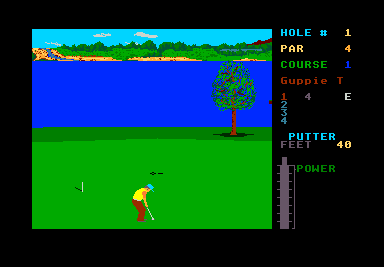
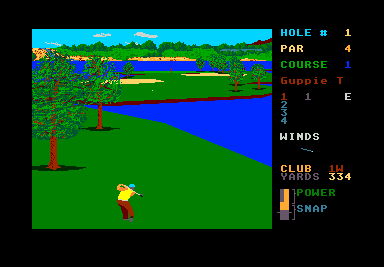
The graphics may not looks like much, but I recall the animation being really something, and the whole thing had a solidity and smoothness that was very pleasing to the eye. Fun fuckin' game, too, I might add. I don't think that's running at the full 512 colors - with these computers of the Second Wave, memory was at such a premium that you could only either have all your colors for still images, or a few of them in motion. Interesting trade-off.
The big art program for the ST computers was something called Neochrome, and that did use all 512 colors, and it was cheap, and you could get very impressive results. Rather than drag in any of the online screen caps floating around, I direct you to this page, which is a top-to-bottom rundown of this pretty remarkable program.
The interface may not look that impressive, and the black background now looks a little odd - kind of like working on digital black velvet, or something - but me and Neochrome got on like gangbusters. For a brief period - I'm going to guess it was during my Junior year of high school in 1986 - I worked up a really stellar collection of images. I preferred to work in solid color blends rather than the as-yet primitive gradient tool that drawing programs at that time offered. With 512 colors, I could get very subtle changes, but since they were clearly different colors rather than pixelated blends, the work had a really strong and sharp graphic design quality to it, like a vibrant Soviet poster.
I only wish I still had these images to show you. It was my first early work that showed that I had some design and color flair, which had never shown up in my mostly black and white cartooning and architectural sketches at that point.
I wish I could, but I can't. Oh, I still have the computer. It's lurking in a closet or under a bed, somewhere. And I guess it might still run. And even if that one didn't, I'm sure I could find one online for very little money. And I'll bet I even still have the Neochrome disk. It's just the art itself that's gone missing.
Well, not missing. It's actually gone stolen, and with my express consent.
Next: Goth Kid Plagiarism
-------------------------------------------
P.S.: As if to underscore the ST's low profile, there seem to be no commercials for it online. But an earlier Atari computer had an unexpected pitchman, and one that seemed to perfectly complete the trifecta with Shatner and Cosby.
So, the Amiga was right out. But released right around that same time, and costing far less, was an Atari computer - the 520ST - that shared the same Motorola processor as the Amiga (and the Mac as well). It originally sold for under $800, and that included an external 3.5" floppy drive and a mouse. 512 colors, 512k, 600x400 resolution. Well, it wasn't the Amiga, but it was a lot cheaper right off the bat and must have been a few hundred less by the time I got mine in '86.
(Warning: dreary and vaguely creepy hardware and OS review, but it gives you the basic feel. No need to watch the whole thing. I didn't.)
[Edited to add 3/28/08: That video is taken from the YouTube page of one Dean Pook(?) who has done a great service by preserving that on line for historical purposes. I thank him and mean no discredit by the above 'dreary' comment - the tone of this blog is generally snarky, and sometimes my stampede for humor can overwhelm my good taste and decency.]
I note with some interest that Microsoft proposed Windows as the operating system for the ST, only to be refused because (Vista fans take note) the Windows development time would have pushed back the ST release by almost two years. Imagine the weird parallel Earth where the biggest video game company morphed into the giant PC monopoly. Instead, we have the giant software monolith that tried to take over the video game market.
I'm not sure exactly when I first became aware of the ST. I guess Atari had been making home computers since the late 70's, but somehow never managed to make a dent in the market. It's only by chance that an acquaintance had the 1040ST, which came with about twice of everything that the 520ST offered. And I liked what I saw. Again, here was someone that used it primarily for gaming, and the game that everyone loved among our group of friends was a really soothing golf sim called Leaderboard.
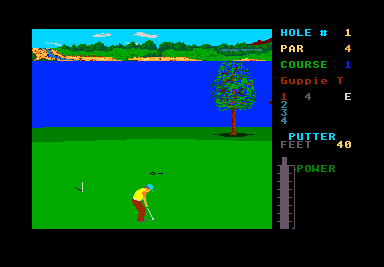
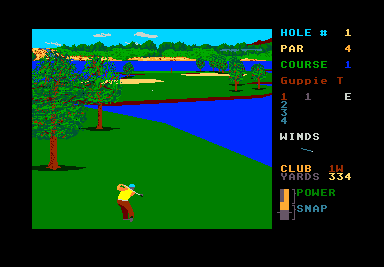
The graphics may not looks like much, but I recall the animation being really something, and the whole thing had a solidity and smoothness that was very pleasing to the eye. Fun fuckin' game, too, I might add. I don't think that's running at the full 512 colors - with these computers of the Second Wave, memory was at such a premium that you could only either have all your colors for still images, or a few of them in motion. Interesting trade-off.
The big art program for the ST computers was something called Neochrome, and that did use all 512 colors, and it was cheap, and you could get very impressive results. Rather than drag in any of the online screen caps floating around, I direct you to this page, which is a top-to-bottom rundown of this pretty remarkable program.
The interface may not look that impressive, and the black background now looks a little odd - kind of like working on digital black velvet, or something - but me and Neochrome got on like gangbusters. For a brief period - I'm going to guess it was during my Junior year of high school in 1986 - I worked up a really stellar collection of images. I preferred to work in solid color blends rather than the as-yet primitive gradient tool that drawing programs at that time offered. With 512 colors, I could get very subtle changes, but since they were clearly different colors rather than pixelated blends, the work had a really strong and sharp graphic design quality to it, like a vibrant Soviet poster.
I only wish I still had these images to show you. It was my first early work that showed that I had some design and color flair, which had never shown up in my mostly black and white cartooning and architectural sketches at that point.
I wish I could, but I can't. Oh, I still have the computer. It's lurking in a closet or under a bed, somewhere. And I guess it might still run. And even if that one didn't, I'm sure I could find one online for very little money. And I'll bet I even still have the Neochrome disk. It's just the art itself that's gone missing.
Well, not missing. It's actually gone stolen, and with my express consent.
Next: Goth Kid Plagiarism
-------------------------------------------
P.S.: As if to underscore the ST's low profile, there seem to be no commercials for it online. But an earlier Atari computer had an unexpected pitchman, and one that seemed to perfectly complete the trifecta with Shatner and Cosby.
Amiga-ga
Raiders of the Lost Art, Part IV
Update: Marina's portfolio, which looked like it might have been found, has now been unfound, presumably in a permanent way. So she's on the scramble to get something together for her early admission review to F.I.T. Everybody who reads the Rambler is now charged to vibe positive vibes in her general direction.
Well, the Apple IIc was a great computer for its time, no doubt about it. But graphics capabilities in home computing were growing by leaps and bounds, and within a very short span, the IIc's meager 16 color capacity and 140 x 192 resolution clearly wasn't going to cut it. As with any tool, I'd learned a few tricks to get around the limitations - hey, when you use the spray paint tool with grey over a solid green backdrop in Dazzle Draw, some glitch makes it look like a field of yellow daisies! - but limitations are only energizing as long as you're unaware of any other options.
(When I get the gallery section on the main site set up, I'll make a point to dig out some of my old Apple artwork and post it in a Juvenilia Gallery there. It would make sense to use it to illustrate this reminiscence, but it's all buried in a file cabinet in the basement, and really am not in the mood to dig it out now. When I actually get around to sorting that stuff 0 presumably as part of the general basement clean-up, I'll make a pile of stuff to scan. The more embarrassing, the better.)
But the Second Wave of Home Computing rolled right along. In an issue of Electronic Games, I came across a short blurb about the forthcoming Commodore Amiga, and the screen cap that accompanied the article broke my brain a little.
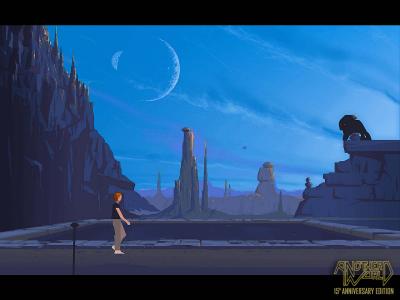
(Note: That's not the original image, but it has something of the flavor of it. The original image, what I remember of it, was some kind of funky gaslight city street, with a ghost walking through it.)
Compare that to this game from other platforms at the time:
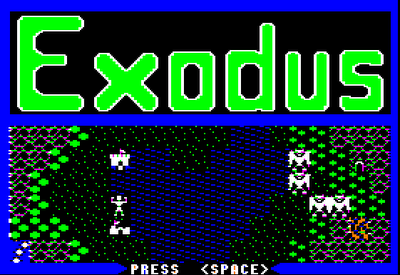
Sure, maybe this comparison is a little skewed, but you get the idea of how it felt. The world grew dark before my eyes and I fell instantly out of love with the IIc. Amiga! 4096 colors! 640 x 512 resolution! This was the computer that really kick-started the use of computers in video use, and even ten years after its demise, you can still save files in Amiga format in Photoshop. I don't think anyone would argue seriously the point that Amiga set the pace for graphics in home computing, and much of what followed sprung from a need to compete with that very high standard.
It had a very high price to go along with that standrad - the Amiga 1000 base configuration went for $1,295 in 1985, and that was way more money than I had on my own, and much, much more than I could argue my dad out of. In fact, I don't recall even trying, since I'd had the IIc for less than a year, and that had been a pretty major expense. So I probably just hung my shoulders in resignation to my 16-color handicapper of an artbot.
It must be noted that at that point, no-one at the consumer level really knew anything about how fast computers were improving, or would continue to improve, and drop in price, and all that. Now, it seems like common knowledge that the computer you buy today will be made obsolete by the next model three months later, with double the processing power and all that. But back in 1985 - and bear in mind that we're talking about a time of rapid flux in the industry, the days before WIndows, when Mac itself was only a year old and not exactly a graphic powerhouse (still only black and white at this point!) - many, many companies had a valid claim to being able to be the market leader.
Commodore had been a big deal with the Vic20 and the C-64, so it was a major scary moment to see the Amiga in action and then look over at my IIc with the sinking feeling that I'd backed the wrong industry horse. Fuck, even the commercials were better, and given Apple's marketing strength (really, always their best department), that's saying something:
Sigh.
Next: NOW I'll get to the Atari part.
Update: Marina's portfolio, which looked like it might have been found, has now been unfound, presumably in a permanent way. So she's on the scramble to get something together for her early admission review to F.I.T. Everybody who reads the Rambler is now charged to vibe positive vibes in her general direction.
Well, the Apple IIc was a great computer for its time, no doubt about it. But graphics capabilities in home computing were growing by leaps and bounds, and within a very short span, the IIc's meager 16 color capacity and 140 x 192 resolution clearly wasn't going to cut it. As with any tool, I'd learned a few tricks to get around the limitations - hey, when you use the spray paint tool with grey over a solid green backdrop in Dazzle Draw, some glitch makes it look like a field of yellow daisies! - but limitations are only energizing as long as you're unaware of any other options.
(When I get the gallery section on the main site set up, I'll make a point to dig out some of my old Apple artwork and post it in a Juvenilia Gallery there. It would make sense to use it to illustrate this reminiscence, but it's all buried in a file cabinet in the basement, and really am not in the mood to dig it out now. When I actually get around to sorting that stuff 0 presumably as part of the general basement clean-up, I'll make a pile of stuff to scan. The more embarrassing, the better.)
But the Second Wave of Home Computing rolled right along. In an issue of Electronic Games, I came across a short blurb about the forthcoming Commodore Amiga, and the screen cap that accompanied the article broke my brain a little.
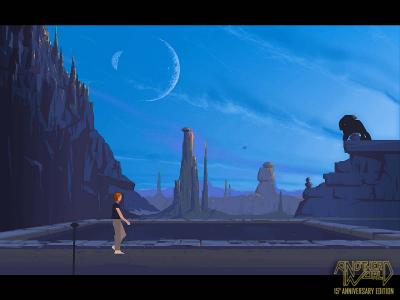
(Note: That's not the original image, but it has something of the flavor of it. The original image, what I remember of it, was some kind of funky gaslight city street, with a ghost walking through it.)
Compare that to this game from other platforms at the time:
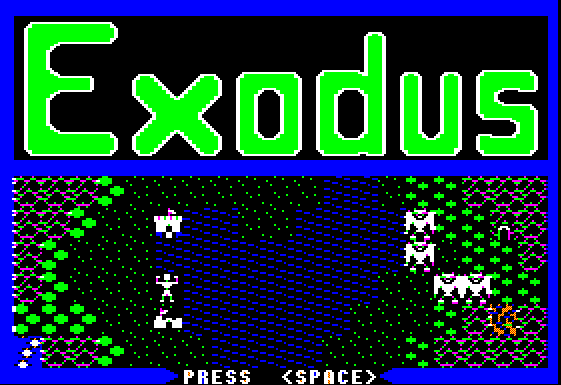
Sure, maybe this comparison is a little skewed, but you get the idea of how it felt. The world grew dark before my eyes and I fell instantly out of love with the IIc. Amiga! 4096 colors! 640 x 512 resolution! This was the computer that really kick-started the use of computers in video use, and even ten years after its demise, you can still save files in Amiga format in Photoshop. I don't think anyone would argue seriously the point that Amiga set the pace for graphics in home computing, and much of what followed sprung from a need to compete with that very high standard.
It had a very high price to go along with that standrad - the Amiga 1000 base configuration went for $1,295 in 1985, and that was way more money than I had on my own, and much, much more than I could argue my dad out of. In fact, I don't recall even trying, since I'd had the IIc for less than a year, and that had been a pretty major expense. So I probably just hung my shoulders in resignation to my 16-color handicapper of an artbot.
It must be noted that at that point, no-one at the consumer level really knew anything about how fast computers were improving, or would continue to improve, and drop in price, and all that. Now, it seems like common knowledge that the computer you buy today will be made obsolete by the next model three months later, with double the processing power and all that. But back in 1985 - and bear in mind that we're talking about a time of rapid flux in the industry, the days before WIndows, when Mac itself was only a year old and not exactly a graphic powerhouse (still only black and white at this point!) - many, many companies had a valid claim to being able to be the market leader.
Commodore had been a big deal with the Vic20 and the C-64, so it was a major scary moment to see the Amiga in action and then look over at my IIc with the sinking feeling that I'd backed the wrong industry horse. Fuck, even the commercials were better, and given Apple's marketing strength (really, always their best department), that's saying something:
Sigh.
Next: NOW I'll get to the Atari part.
Subscribe to:
Posts (Atom)